
archaeo.social and archaeo.dev: decentralised, collective digital infrastructure for archaeologists
Joe Roe, Zachary Batist, James A. Fellows Yates, and Andrea Titolo
Presented at the Computer Applications and Quantitative Methods in Archaeology (CAA) annual conference, Vienna, 31 March – 4th April 2026, 2026.
Abstract
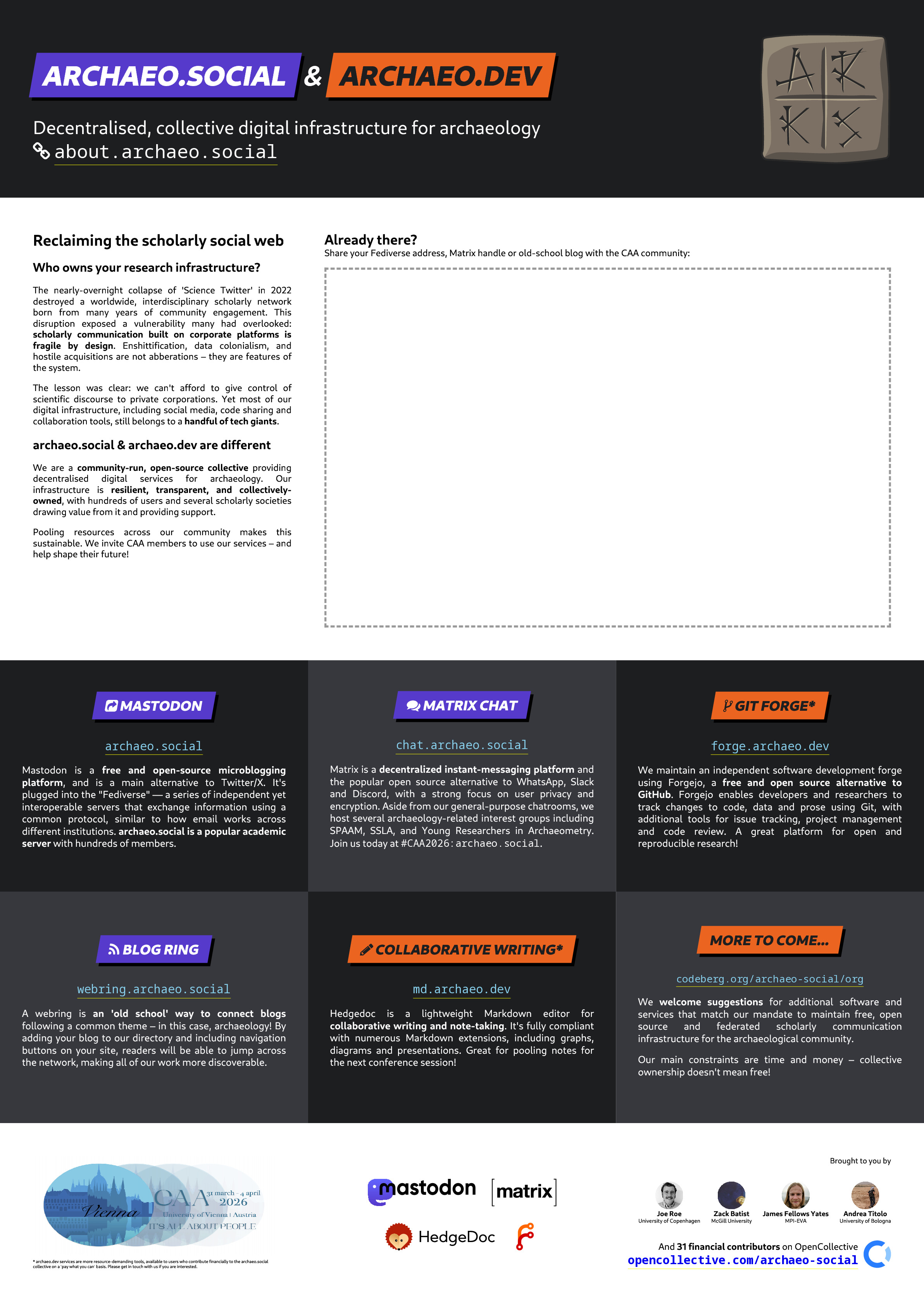
In November 2022, the microblogging service Twitter (now X) was acquired by billionaire Elon Musk, triggering the first of several exoduses of its users. Amongst those who left the site for other platforms, or who simply stopped using it, were archaeologists and other scientists. ‘Science Twitter’ had been a prominent venue for scholarly communication on social media, providing a platform for researchers to talk directly to each other and to the public (Insall 2023). Its sudden disintegration was a wake-up call for many, highlighting the risks of entrusting public scientific discourse to a single private corporation. Subsequent events have only reinforced academia’s need for digital services that are resilient to corporate capture, ‘enshittification’, and data colonialism (Brembs et al. 2023). And yet much of the digital infrastructure we rely upon as archaeologists—not just in terms of social media and communication, but software development, code sharing, collaboration, and so on—remains concentrated with a few large corporations.
archaeo.dev (https://archaeo.dev) is a scholarly collective that maintains decentralised digital services for archaeologists. We use free and open source software to promote a ‘do it yourself’ approach to digital research and scholarly communication tools, with the aim of breaking our field’s dependence on centralised, proprietary platforms. The collective began in 2022 with archaeo.social (https://archaeo.social), a federated social media platform created in response to the ‘scientific exodus’ from Twitter. Since then, we have built on the model with other decentralised services, including instant messaging platform Matrix (https://chat.archaeo.social), software development platform Forgejo (https://forge.archaeo.dev), and collaborative text editor HedgeDoc (https://md.archaeo.dev). These are used by and supported by hundreds of individual users and a number of scholarly societies. Though ‘free as in freedom’, maintaining these services does require an investment in money, time, labour, and skills in system administration – creating a significant barrier to entry for individual scholars. The aim of archaeo.dev is to overcome this barrier by pooling our resources and operating these tools collectively. With this poster, we invite members of the CAA community both to use them, and help us build them further.
References
- Brembs, Björn, Adrian Lenardic, Peter Murray-Rust, Leslie Chan, and Dasapta Erwin Irawan. 2023. “Mastodon over Mammon: Towards Publicly Owned Scholarly Knowledge.” Royal Society Open Science 10 (7): 230207. https://doi.org/10.1098/rsos.230207.
- Insall, Robert. 2023. “Science Twitter — Navigating Change in Science Communication.” Nature Reviews Molecular Cell Biology 24 (5, 5): 305–6. https://doi.org/10.1038/s41580-023-00581-3.
Links
- Poster
- Source repository (forge.archaeo.dev)