
XRONOS: An open data infrastructure for archaeological chronology
Joe Roe and Martin Hinz
Presented at the Computer Applications and Quantitative Methods in Archaeology (CAA) annual conference, Vienna, 31 March – 4th April 2026, 2026.
Abstract
Computational archaeologists have benefited immensely from our field’s embrace of open data and open science approaches. One of the principle domains in which this has been applied in recent years is chronometric data. Comprehensive compilations of radiocarbon dates have become available for many parts of the world in the last decade and, as natural next step, there are now several initiatives to collate this data globally, including the retrieval tool c14bazAAR (Schmid et al. 2019), the IntChron exchange format (Bronk Ramsey et al. 2019), and the synthetic database p3kc14 (Bird et al. 2022). But this effort is far from complete. Radiocarbon datasets are still sorely lacking for many parts of the world and, even in those regions with good coverage, the quality of data is highly uneven and largely undocumented. There exists no central repository ensuring the long-term sustainability and completeness of these datasets, and the potential of placing other sources of chronometric information (e.g. dendrochronology, typological dating) in an open data framework has hardly been realised at all.
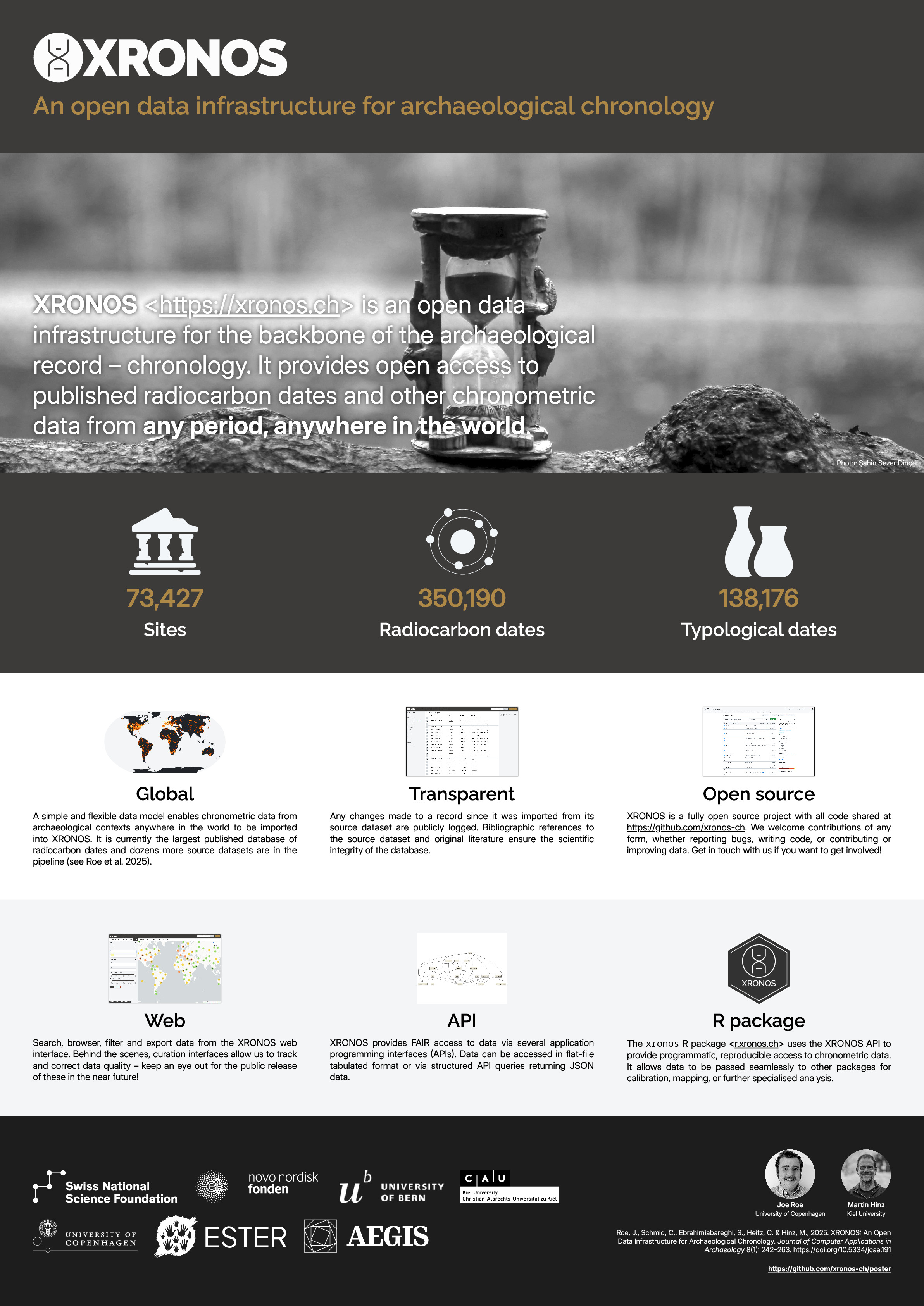
Here, building on and complementing these initiatives, we present XRONOS (Roe et al. 2025, https://xronos.ch), an open data infrastructure for archaeological chronology. It provides open access to published radiocarbon dates and other chronometric data from any period, anywhere in the world. By collating a large number of existing regional and global compilations of dates, XRONOS offers the most comprehensive radiocarbon database yet published, with over 350,000 radiocarbon and 75,000 site records. It also provides a foundation for expanding the systematic collection of chronometric information beyond radiocarbon, with support for typological and dendrochronological dates and a generalisable data model that can be adapted to other methods of absolute dating. Automated and semi-automated quality control processes ensure that data from diverse sources is continuously integrated and standardised, making it easier to find information of interest and reducing the need for manual data cleaning by end users. The XRONOS framework provides more open, more reliable, and more comprehensive access to chronometric data than previously available, that has already helped futher the application of quantitative and computational methods in archaeological chronology.
References
- Bird, Darcy, Lux Miranda, Marc Vander Linden, Erick Robinson, R. Kyle Bocinsky, Chris Nicholson, José M. Capriles, et al. 2022. “p3k14c, a Synthetic Global Database of Archaeological Radiocarbon Dates.” Scientific Data 9 (1): 27. https://doi.org/10.1038/s41597-022-01118-7.
- Bronk Ramsey, Christopher, Maarten Blaauw, Rebecca Kearney, and Richard A Staff. 2019. “The Importance of Open Access to Chronological Information: The IntChron Initiative.” Radiocarbon 61 (5): 1121–31. https://doi.org/10.1017/RDC.2019.21.
- Roe, Joe, Clemens Schmid, Setareh Ebrahimiabareghi, Caroline Heitz, and Martin Hinz. 2025. “XRONOS: An Open Data Infrastructure for Archaeological Chronology.” Journal of Computer Applications in Archaeology 8 (October): 242–63. https://doi.org/10.5334/jcaa.191.
- Schmid, Clemens, Dirk Seidensticker, and Martin Hinz. 2019. “c14bazAAR: An R Package for Downloading and Preparing C14 Dates from Different Source Databases.” Journal of Open Source Software 4 (43): 1914. https://doi.org/10.21105/joss.01914.
Links
- Poster
- Source code (Zenodo)
- Source repository